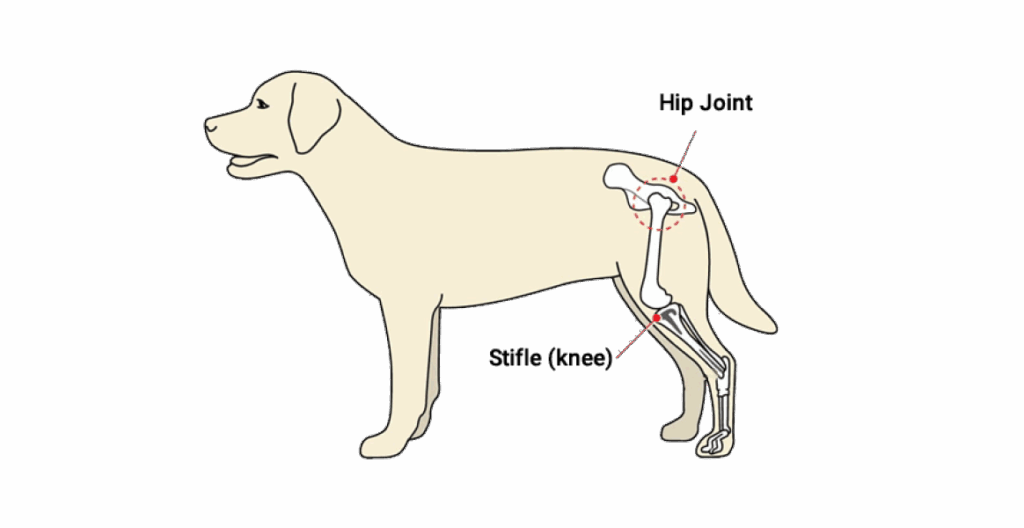
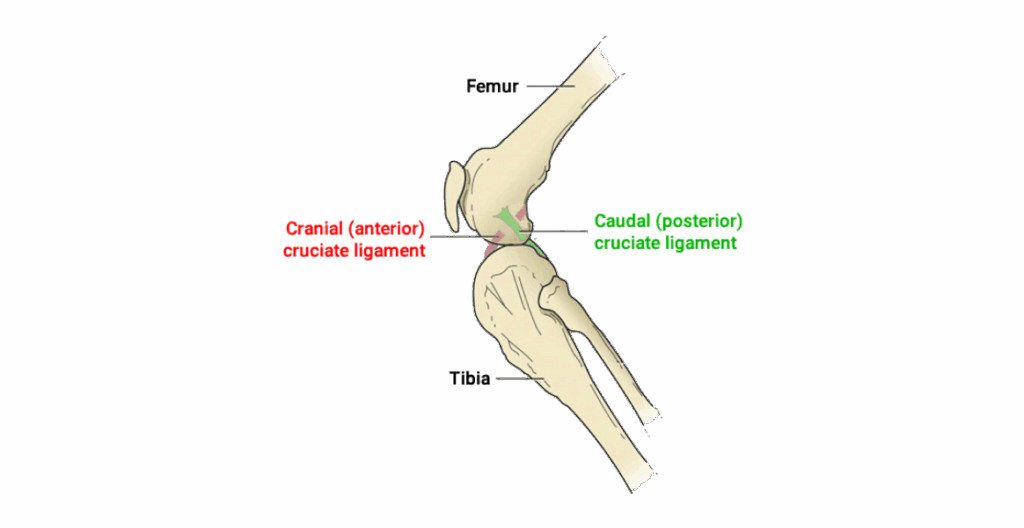
Let’s begin with a quick lesson on canine anatomy. In four-legged animals the equivalent of the human knee joint is called the stifle joint. The stifle joint of a dog is a complex joint where the femur (the thigh bone) meets the tibia (the shin bone).
The stifle joint is held together by four ligaments. There are ligaments on either side of the joint (called the medial and lateral collateral ligaments). There are two ligaments within the joint that form a cross shape between the bottom of the femur and the top of the tibia, and these are the cruciate ligaments.
One of the cruciate ligaments is called the cranial cruciate ligament, because it lies in front of the other. The other is called the caudal cruciate ligament.
It is rare to see damage to the caudal cruciate ligament in dogs but it is common to see damage to the cranial cruciate ligament.
Cruciate disease is the gradual deterioration and weakening of the cranial cruciate ligament. It has a hereditary cause in that some dogs are prone to it, but occasionally it can be caused (as in the classic footballers injury in humans) by trauma – sudden twisting or turning for example. Eventually the ligament can become so weak that it tears, leading to an unstable stifle joint that requires surgery.
Cruciate disease is more common in large dogs, older dogs, dogs that are obese or unfit and those dogs that have a particularly steep slope to the top of the tibia. Not all dogs with cruciate disease go on to tear the cruciate ligament but many do. Whether the cranial cruciate ligament tears completely or not, it is inevitable that a joint with cruciate disease will develop arthritis.
How Stem Cell Therapy can help
Ligaments heal slowly. The weakening of the cranial cruciate ligament in dogs with cruciate disease happens when the rate of damage to the ligament is faster than the rate at which the body can repair the ligament.
Regenerative medicine can increase the potential for the body to repair the cranial cruciate ligament. It is thought that regenerative medicine also helps to reduce the progression of arthritis within the joint.
Treatment with regenerative medicine is likely to be most effective when given early in the course of cruciate disease. It is not effective when the cranial cruciate ligament has torn or is close to tearing.
However where there is a partial cruciate ligament tear, stem cell therapy can be used as a treatment option.
Ligaments heal slowly. The weakening of the cranial cruciate ligament in dogs with cruciate disease happens when the rate of damage to the ligament is faster than the rate at which the body can repair the ligament.
Regenerative medicine can increase the potential for the body to repair the cranial cruciate ligament. It is thought that regenerative medicine also helps to reduce the progression of arthritis within the joint.
Treatment with regenerative medicine is likely to be most effective when given early in the course of cruciate disease. It is not effective when the cranial cruciate ligament has torn or is close to tearing.
However where there is a partial cruciate ligament tear, stem cell therapy can be used as a treatment option.